Biomedical Engineering
From one-size-fits-all to patient-specific digital twins
 ∂u/∂t = D∇²uQ = ΔP/Rσ = Eε(1 + αt)
The Traditional Practice
Biomedical engineering has been computational for decades. Finite element analysis of orthopedic implants, computational fluid dynamics of blood flow through heart valves, pharmacokinetic modeling of drug absorption — these are established tools. Medical device companies run thousands of simulations during design verification, and pharmaceutical firms use computational chemistry to screen drug candidates.
But traditional computational biomedical engineering treats patients as populations, not individuals. A hip implant is designed for the 5th-to-95th percentile femur geometry. A drug dosage is calibrated to a statistical "average" patient. A prosthetic heart valve is tested against standardized hemodynamic conditions. The computation is sophisticated, but the inputs are generic.
Digital engineering in biomedical is about closing the loop between computation and the individual patient — and using AI to navigate biological complexity that deterministic models cannot capture alone.
What's Different Now
From Population-Average Devices to Patient-Specific Digital Twins
Traditional medical device design uses standardized anatomy. An orthopedic implant is designed for a representative bone geometry derived from cadaver studies and population statistics. A cardiac device is tested against a "normal" heart model. This means every patient receives a device optimized for someone who doesn't actually exist — the statistical average.
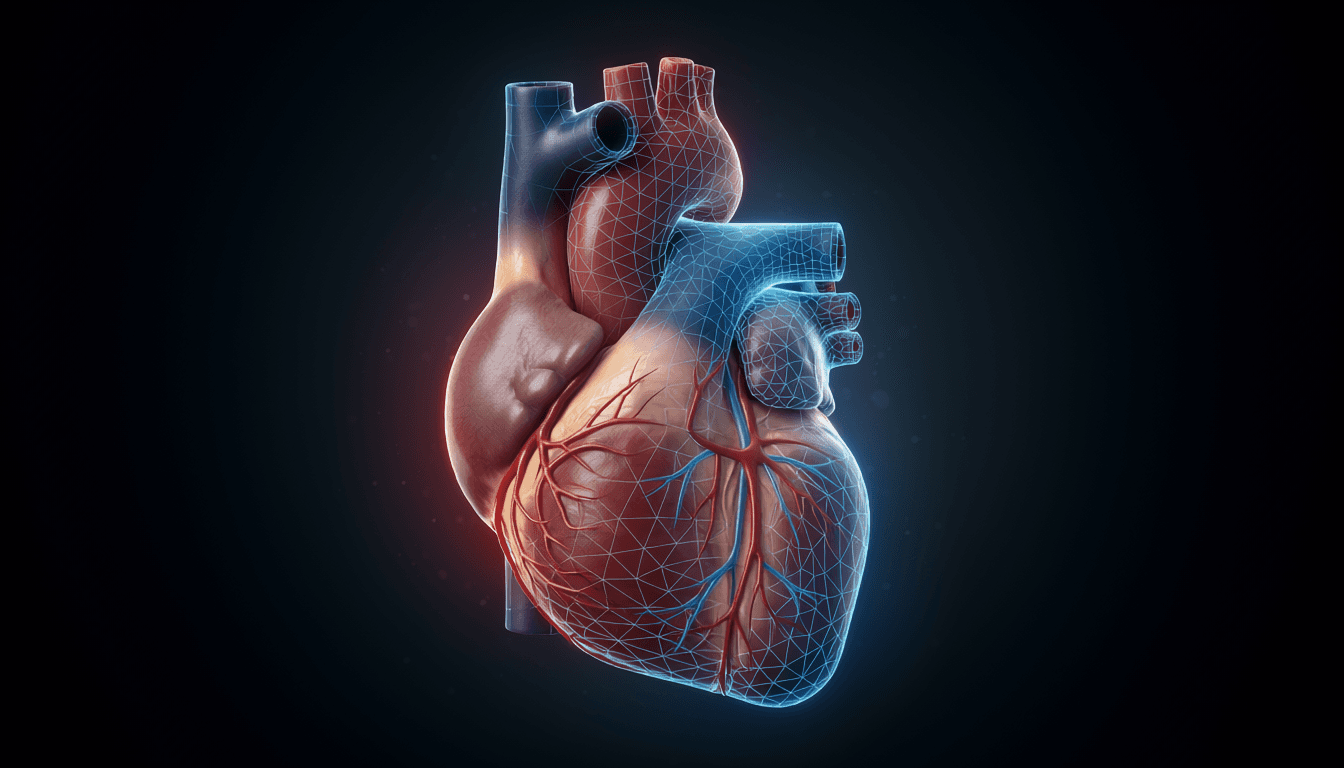
Patient-specific digital twins change this fundamentally. A cardiac digital twin starts with the patient's own MRI or CT data, reconstructs their specific chamber geometry, wall thickness, and fiber orientation, then calibrates an electromechanical model to match that patient's ECG and echocardiography data. The result is a simulation of this patient's heart — not an average heart.
This enables:
- Pre-surgical planning: Simulating the outcome of valve replacement or ablation therapy on the patient's specific anatomy before the procedure
- Device sizing and selection: Choosing the implant configuration that performs best in this patient's geometry, not the population average
- Risk stratification: Predicting which patients are likely to develop complications based on their individual biomechanical and physiological parameters
The shift: From designing for the average patient to simulating the specific patient.
Reference: FDA's Center for Devices and Radiological Health (CDRH) has published guidance on computational modeling and simulation in medical device submissions. ASME V&V 40 provides a framework for assessing computational model credibility for medical devices. The "Living Heart Project" and similar academic initiatives at Johns Hopkins, Stanford, and King's College London have demonstrated patient-specific cardiac digital twins.
From Sequential Drug Development to AI-Compressed Discovery
Traditional pharmaceutical development is linear and slow: target identification, lead discovery, lead optimization, preclinical testing, then three phases of clinical trials. This pipeline takes 10-15 years and costs $1-2 billion per approved drug, with a 90% failure rate in clinical trials.
AI-accelerated drug discovery compresses multiple stages:
- Protein structure prediction: ML models predict three-dimensional protein structures from amino acid sequences, replacing years of experimental crystallography for many targets
- Generative molecular design: AI generates novel candidate molecules optimized for binding affinity, selectivity, and drug-like properties — exploring chemical space far beyond what medicinal chemists can survey manually
- In-silico ADMET prediction: ML models predict absorption, distribution, metabolism, excretion, and toxicity from molecular structure, filtering out likely failures before expensive synthesis and testing
- Clinical trial optimization: AI identifies patient subpopulations most likely to respond, reducing required trial sizes and increasing success rates
This is different from traditional computational chemistry (molecular dynamics, docking simulations) because the AI models learn patterns from vast datasets of experimental results rather than simulating physics from first principles — enabling predictions for complex biological interactions that physics-based models struggle with.
The shift: Drug development compresses from a 15-year sequential pipeline to a parallelized, AI-guided process that eliminates dead ends earlier.
Reference: FDA's Model-Informed Drug Development (MIDD) framework promotes computational approaches throughout drug development. NIH's National Center for Advancing Translational Sciences (NCATS) funds AI-driven drug discovery programs. IEEE Transactions on Biomedical Engineering publishes extensively on ML for drug discovery.
From Physical Clinical Trials to In-Silico Evidence
Traditional regulatory approval requires physical clinical trials — testing devices and drugs on real patients in controlled studies. These trials are essential but limited: they test a fixed design on a specific patient cohort under specific conditions. They can't predict how the device will perform in patients who weren't in the trial, or under conditions that weren't tested.
In-silico clinical trials use computational modeling to supplement or partially replace physical trials:
- Virtual patient populations: Generate thousands of anatomically and physiologically diverse computational patients from statistical models of population variability, then simulate device performance across the entire virtual population
- Edge-case testing: Identify rare anatomies or physiological conditions where the device might fail — conditions that physical trials with hundreds of patients are unlikely to encounter
- Design iteration without new trials: When a device design changes, re-run the virtual trial rather than conducting a new physical study
This doesn't eliminate the need for physical clinical evidence, but it changes the role of physical trials from broad exploration to targeted confirmation — testing physically what the computational evidence identifies as highest-risk scenarios.
The shift: Regulatory evidence becomes a combination of computational and physical data, with in-silico methods covering breadth and physical trials providing depth.
Reference: FDA CDRH's guidance on "Reporting of Computational Modeling Studies in Medical Device Submissions." The Avicenna Alliance (European initiative for in-silico clinical trials). ASME V&V 40 standard on verification and validation of computational modeling for medical devices.
From Static Implants to Computationally Designed Living Constructs
Traditional implant design produces inert devices — a titanium hip stem, a cobalt-chrome knee component, a silicone breast implant. These devices replace tissue function mechanically but don't integrate biologically beyond the surface.
Computational bioprinting designs constructs that are biologically active:
- Scaffold architecture optimization: ML algorithms design porous scaffold geometries that optimize simultaneously for mechanical load-bearing, nutrient diffusion, and cell migration — a multi-objective problem with conflicting constraints that manual design cannot solve efficiently
- Bioink formulation: Computational models predict how cell-laden hydrogel compositions will behave during printing (shear-thinning, gelation kinetics) and after printing (cell viability, differentiation, matrix remodeling)
- Vascularization planning: Algorithms design branching vascular networks within thick constructs, solving the diffusion limitation that has historically prevented engineering of tissues thicker than a few hundred microns
The shift: From designing inert mechanical replacements to computationally orchestrating living tissue constructs.
Reference: Biomedical Engineering Society (BMES) and its Tissue Engineering special interest group. NIH's National Institute of Biomedical Imaging and Bioengineering (NIBIB) funds computational biofabrication research. Biofabrication journal (IOP Science) publishes on computational approaches to bioprinting.
The Tool Ecosystem
Tool Ecosystem: Traditional vs. DE-Native
What Biomedical Engineers Need to Learn
Biomedical engineering fundamentals — biomechanics, physiology, regulatory science, biocompatibility — remain essential. The digital engineering additions:
- Medical image processing: Segmentation, registration, and reconstruction of patient-specific anatomy from CT, MRI, and ultrasound — the foundation for patient-specific digital twins
- Machine learning for biological data: Biological data is noisy, high-dimensional, and often sparse. Learning to work with clinical datasets, imaging data, and -omics data requires specific ML skills beyond standard engineering data science
- Regulatory computational literacy: Understanding FDA and international guidance on computational evidence — how to make credibility arguments for computational models under ASME V&V 40 and related frameworks
- Systems biology integration: Connecting device-level or molecule-level models to patient-level physiological systems — the digital twin must capture the interaction between the engineering intervention and the biological response
Key Organizations and Resources
- FDA CDRH — Center for Devices and Radiological Health, guidance on computational modeling in device submissions, MIDD framework for drug development
- BMES — Biomedical Engineering Society, conferences and publications spanning computational biomedical engineering
- IEEE TBME — IEEE Transactions on Biomedical Engineering, leading journal for computational methods in biomedical applications
- NIH NCATS — National Center for Advancing Translational Sciences, funding for AI-driven drug discovery and translational computational methods
- ASME V&V 40 — Standard for verification and validation of computational modeling of medical devices
- NIBIB — National Institute of Biomedical Imaging and Bioengineering, funding for computational biofabrication and imaging-based modeling