Chemical Engineering
From steady-state simulation to self-optimizing plants
 k = Ae^(-Ea/RT)∂C/∂t = D∇²C - v·∇CΔG = ΔH - TΔS
The Traditional Practice
Chemical engineering has always been computational. Steady-state process simulation (Aspen Plus, HYSYS), thermodynamic modeling (NRTL, Peng-Robinson), and reaction kinetics have been core tools since the 1970s. Material and energy balances, heat exchanger design, and distillation column sizing are fundamentally mathematical problems.
So when we say digital engineering is transforming chemical engineering, we don't mean "chemical engineers are starting to use computers." They've done that for decades. The transformation is in how computation, data, and AI are integrated — and what that integration makes possible that traditional computational ChemE couldn't do.
What's Different Now
From Steady-State to Real-Time
Traditional process simulation runs offline. An engineer builds a model in Aspen, runs it to predict steady-state performance, and uses the results to design equipment and set operating conditions. The model is a design tool — used before the plant is built, then largely set aside.
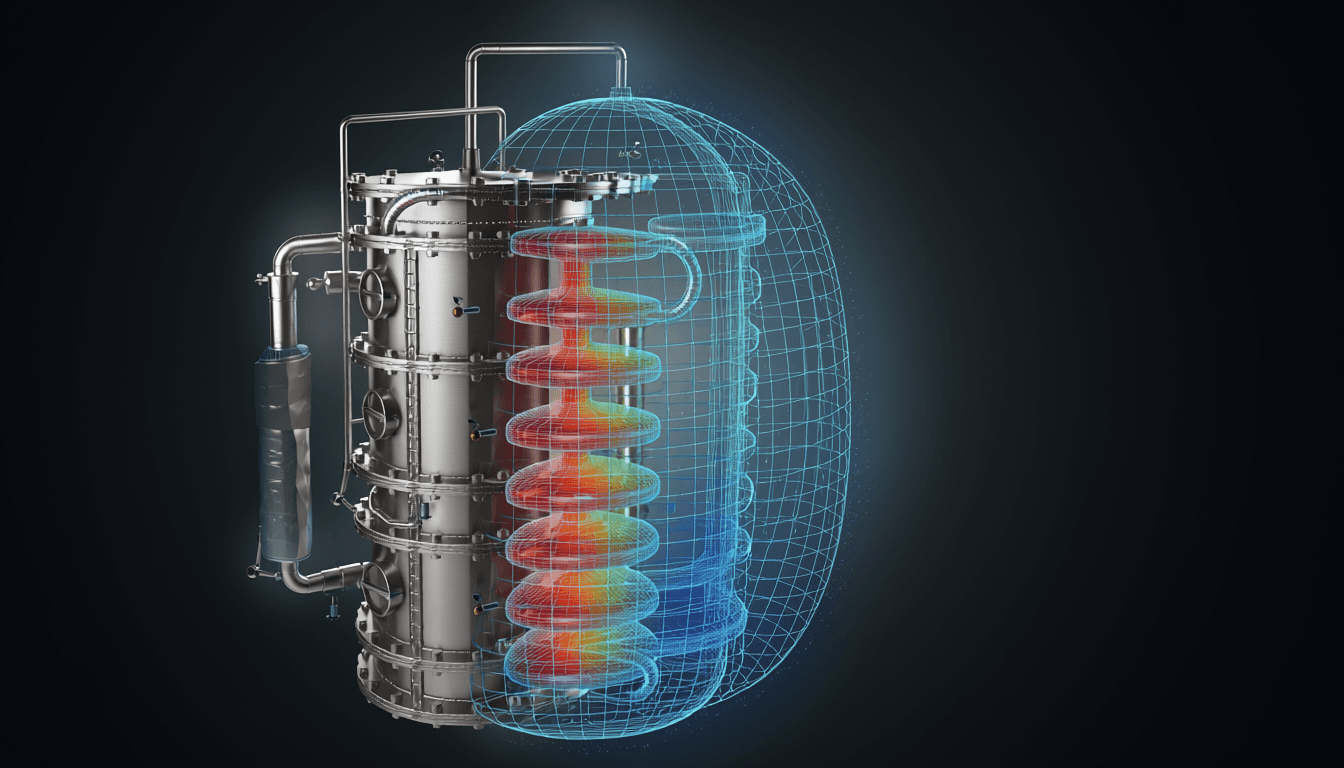
Digital engineering makes simulation operational. A real-time digital twin of a reactor or distillation column ingests live data from the Distributed Control System (DCS) — temperatures, pressures, flow rates, compositions — and continuously reconciles the physics model with actual conditions. When the model and the plant diverge, that divergence is information: a catalyst is deactivating, fouling is building, or an input stream has changed composition.
The shift: Simulation moves from a one-time design prediction to a continuous operational intelligence system.
Reference: AIChE's SMART Manufacturing initiative promotes this transition, with member companies implementing real-time process twins across refining, petrochemical, and specialty chemical operations.
From First-Principles to Hybrid Models
Classical ChemE models are first-principles: conservation of mass, energy, and momentum, plus thermodynamic equations of state and kinetic rate expressions. These work well for well-characterized systems. They struggle with:
- Complex reaction networks where kinetics are only partially known
- Fouling, aging, and degradation that aren't captured in design-basis models
- Real plant conditions that deviate from the idealized assumptions in textbooks
Hybrid models combine first-principles with machine learning. The physics provides structure (mass balances still close, energy is conserved), and ML fills in what physics can't predict — empirical corrections, unmeasured disturbances, and process drift.
A hybrid model of a polymerization reactor, for example, might use first-principles for the heat balance and reaction stoichiometry, but use a neural network trained on plant data to predict molecular weight distribution — a property that depends on complex kinetics and mixing patterns that are impractical to model from first principles at industrial scale.
The shift: Models that are partially physics, partially data-driven — more accurate than either alone.
Reference: AIChE Journal has published extensively on physics-informed neural networks (PINNs) for chemical process modeling. The concept builds on work from the DECHEMA (German Society for Chemical Engineering) and academic groups at MIT, Georgia Tech, and Imperial College.
From Manual Experimentation to Autonomous R&D
In traditional R&D, a chemist or engineer designs experiments based on experience and intuition, runs them one at a time (or in small batches), analyzes results, and decides what to try next. This is slow, expensive, and biased by the experimenter's assumptions.
Bayesian optimization changes this. An AI system maintains a probabilistic model of the relationship between experimental inputs (temperature, pressure, catalyst loading, residence time) and outputs (yield, selectivity, purity). After each experiment, the model updates and proposes the next experiment to maximize information gain — systematically exploring the design space while exploiting promising regions.
Self-driving laboratories take this further: robotic systems that plan, execute, and analyze experiments autonomously, with human scientists setting objectives and reviewing results.
The shift: Experimentation becomes data-driven and algorithmic, not intuition-driven and sequential.
Reference: The AIChE Center for Chemical Process Safety (CCPS) and the ACS (American Chemical Society) have published standards and case studies on ML-assisted process development. Companies like Dow, BASF, and Evonik have disclosed autonomous experimentation programs.
From Reactive Safety to Predictive Risk
Chemical plants operate under tight safety constraints — HAZOP studies, layers of protection, emergency shutdown systems. These are fundamentally reactive: they define what to do when something goes wrong.
Digital engineering enables predictive safety:
- Anomaly detection: ML models trained on years of normal operation data detect subtle deviations — a slow drift in catalyst activity, an unusual vibration pattern in a compressor — before they reach alarm thresholds
- Predictive maintenance: Sensor data from rotating equipment (pumps, compressors, agitators) feeds ML models that predict remaining useful life, enabling maintenance during planned shutdowns rather than emergency stops
- Dynamic risk assessment: Real-time process data feeds into quantitative risk models that continuously estimate the probability of hazardous events, replacing static risk assessments that are updated annually
The shift: Safety moves from "what to do when things go wrong" to "what's about to go wrong and how to prevent it."
Reference: AIChE CCPS's Process Safety Beacon and guidelines on ML for safety-critical applications. The Center for Operator Performance (COP) research on AI-augmented control room decision support.
The Tool Ecosystem
Tool Ecosystem: Traditional vs. DE-Native
What Chemical Engineers Need to Learn
Digital engineering doesn't replace ChemE fundamentals — it requires them. You can't build a hybrid model if you don't understand the first-principles part. You can't do predictive safety if you don't understand process hazards.
What's added:
- Data literacy: Understanding how plant data is structured, cleaned, and prepared for modeling
- ML fundamentals: Enough to evaluate when ML is appropriate and when first-principles suffice
- Systems thinking: How data flows across the enterprise — from R&D to design to operations to supply chain
- Computational tools: Python, data pipelines, API integration — the connective tissue between domain knowledge and computational capability
Key Organizations and Resources
- AIChE — SMART Manufacturing initiative, CCPS, Institute for Learning & Innovation
- DECHEMA — European chemical engineering society, strong on process intensification and digitalization
- ISA (International Society of Automation) — Standards for process control and industrial cybersecurity
- ACS — American Chemical Society, computational chemistry and ML in chemistry
- CESMII — Clean Energy Smart Manufacturing Innovation Institute (DOE)