Electrical Engineering
From manual layout to AI-driven design at billion-transistor scale
 ∇×E = -∂B/∂tV = IRP = VI cos(θ)
The Traditional Practice
Electrical engineering has been computational since SPICE circuit simulation emerged in the 1970s. PCB layout, power system load flow analysis, electromagnetic field simulation, signal integrity analysis, and control system design all rely on mature computational tools. Digital logic design uses hardware description languages that are themselves compiled and simulated. Power engineers have modeled grid stability with load flow and transient analysis software for decades.
The digital engineering transformation in EE isn't about adopting computation — it's about using AI to manage scales of complexity that traditional computational methods can't handle, and connecting design-time models to operational systems in ways that the discipline's siloed tool chains never supported.
What's Different Now
From Human-Guided Chip Layout to AI-Driven Design at Billion-Transistor Scale
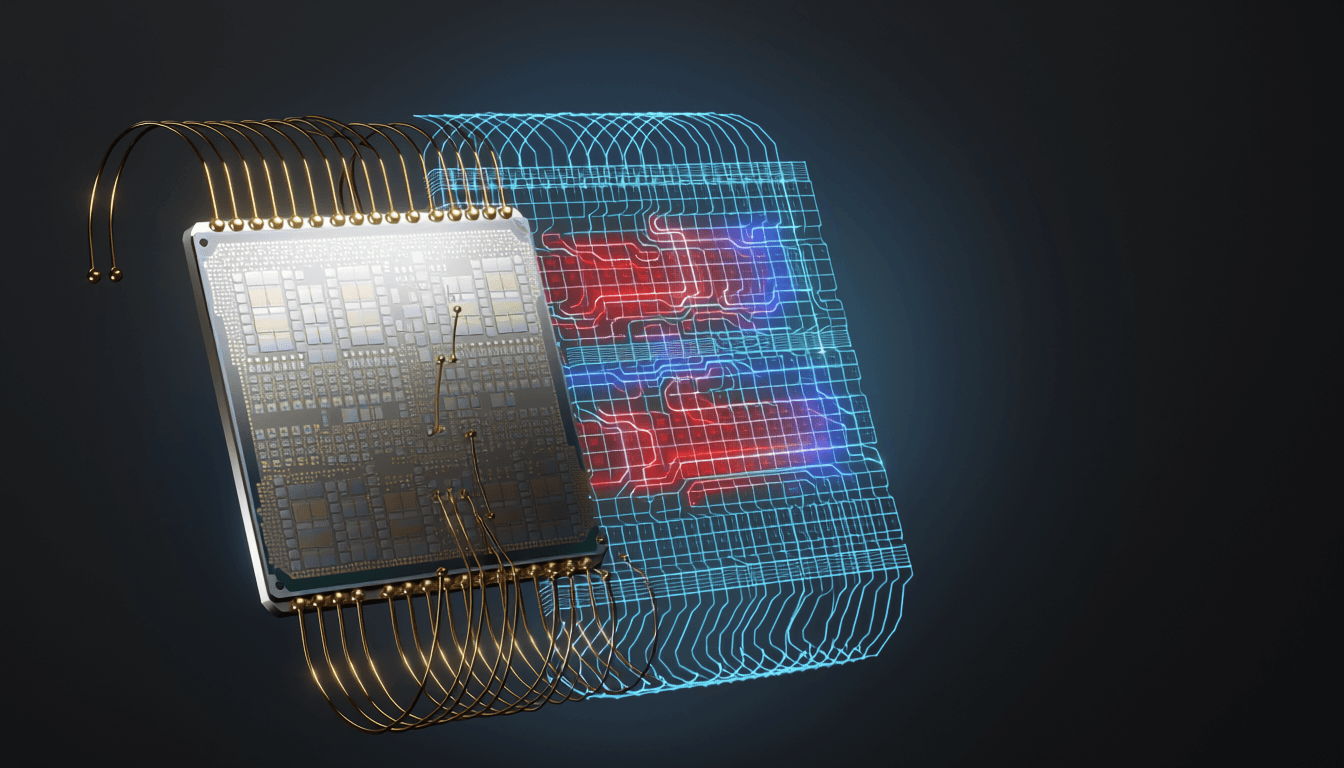
Traditional integrated circuit design follows a hierarchical, human-driven flow: architects define the microarchitecture, logic designers write RTL, synthesis tools map to gates, and physical design engineers guide placement and routing. At each stage, experienced engineers make critical decisions — floorplanning (where to place major blocks), clock tree synthesis, power distribution, and timing closure. A team of dozens might spend 12-18 months on physical design for a modern processor.
AI-driven chip design is changing this at the stages where human intuition can't scale:
- Reinforcement learning for floorplanning: An RL agent learns to place macro blocks on a chip by optimizing for wire length, congestion, timing, and power simultaneously — exploring millions of configurations that a human floorplanning expert could never evaluate manually. Published research demonstrates results competitive with months of human expert effort, achieved in hours
- ML-assisted timing closure: Neural networks predict timing violations early in the flow (before the full extraction and analysis that takes hours to run), letting designers fix problems before they compound
- Automated analog design: Analog circuit sizing and layout — traditionally a deeply manual, expert-driven task — is being partially automated with Bayesian optimization and evolutionary algorithms
The driver is raw complexity. A modern system-on-chip contains billions of transistors. The design space is so vast that human intuition, even augmented by traditional EDA algorithms, leaves significant optimization potential on the table.
The shift: Physical design moves from human-guided heuristic optimization to AI-explored design spaces at a scale humans cannot navigate.
Reference: IEEE Transactions on Computer-Aided Design of Integrated Circuits. ACM/IEEE Design Automation Conference (DAC) proceedings. IEEE Solid-State Circuits Society publications. DARPA Electronics Resurgence Initiative (ERI) and IDEA program (Intelligent Design of Electronic Assets).
From Static Grid Models to Renewable-Integrated Digital Twins
Traditional power system analysis models the grid as a relatively stable system: large central generators produce power, transmission lines carry it, distribution networks deliver it. Load flow analysis, fault studies, and stability analysis assume predictable generation and slowly varying demand. The computational tools (power flow solvers, transient stability simulators) are well-established.
Renewable energy breaks these assumptions. Solar and wind generation is intermittent and distributed — thousands of small generators instead of dozens of large ones. Battery storage adds bidirectional power flow. Electric vehicles create mobile, unpredictable loads. The grid becomes a complex adaptive system that static analysis can't adequately model.
Grid digital twins address this:
- Real-time state estimation: ML models fuse data from SCADA, phasor measurement units (PMUs), smart meters, and weather forecasts to estimate the grid's state at sub-second intervals — far faster than traditional state estimators that run every few minutes
- Predictive stability assessment: Neural networks trained on thousands of simulated contingencies predict whether the grid will remain stable after a disturbance — providing early warning in milliseconds rather than running full transient simulations that take minutes
- Optimal dispatch with uncertainty: Stochastic optimization that accounts for forecast uncertainty in solar, wind, and demand to schedule generation, storage, and demand response
The shift: Grid management moves from deterministic analysis of a stable system to probabilistic real-time management of an inherently variable one.
Reference: IEEE Power & Energy Society (PES) publications and conferences (PESGM). DOE Grid Modernization Initiative and Grid Modernization Laboratory Consortium (GMLC). NIST Smart Grid Framework (NIST SP 1108). NERC (North American Electric Reliability Corporation) standards on grid reliability.
From Manual Verification to AI-Scaled Formal Methods
Traditional verification of digital circuits relies on simulation: engineers write testbenches that exercise the design with input stimuli and check that outputs match expected behavior. For a complex chip, simulation covers only a tiny fraction of possible input combinations — verification teams spend enormous effort writing directed tests and coverage models, yet functional bugs still escape to silicon.
Formal verification mathematically proves that a design satisfies its specification for all possible inputs — not just the ones in the testbench. The challenge is that formal methods suffer from state space explosion: as designs grow, the computational cost of formal proofs grows exponentially. Traditional formal verification was practical only for small blocks or specific properties.
AI is making formal verification scale:
- ML-guided proof strategies: Neural networks learn which proof decomposition strategies are likely to succeed for a given design structure, dramatically reducing the search space for the formal engine
- Automated abstraction: ML identifies which parts of the design can be safely abstracted away for a given property, reducing the state space without losing soundness
- Intelligent property generation: NLP models analyze design specifications and automatically generate formal properties to verify — addressing the bottleneck that writing formal specifications is as hard as writing the design itself
The shift: Verification moves from incomplete simulation-based sampling to formal proof at a scale that AI makes tractable for modern chip complexity.
Reference: IEEE Transactions on Computer-Aided Design. ACM SIGDA (Special Interest Group on Design Automation). IEEE International Conference on Formal Methods in Computer-Aided Design (FMCAD). NIST publications on hardware assurance and trusted electronics.
From Isolated Embedded Systems to AI-at-the-Edge
Traditional embedded system design follows a clear separation: hardware engineers design the board, firmware engineers write low-level code, and the system performs fixed functions defined at design time. The computational constraints are tight — limited memory, limited processing power, real-time deadlines — and the design methodology is conservative.
AI at the edge changes what embedded systems can do:
- On-device ML inference: Neural network models optimized for microcontrollers (TinyML) enable real-time classification, anomaly detection, and predictive maintenance on devices with kilobytes of RAM — no cloud connectivity required
- Hardware-software co-design: The choice of ML model architecture, quantization strategy, and hardware accelerator are co-optimized rather than designed independently. The model is designed for the hardware, and the hardware is designed for the model class
- Continuous learning: Edge devices that update their models based on local data, adapting to changing conditions without requiring firmware updates from a central server
The proliferation of embedded systems (IoT, industrial sensors, autonomous systems, medical devices) means that the traditional design-once-deploy-forever model is giving way to systems that learn and adapt in the field.
The shift: Embedded systems move from fixed-function hardware to adaptive AI-capable platforms that evolve after deployment.
Reference: IEEE Embedded Systems Letters. ACM Transactions on Embedded Computing Systems. TinyML Foundation academic network. NIST IoT standards and cybersecurity frameworks. IEEE Standards Association IoT working groups.
The Tool Ecosystem
Tool Ecosystem: Traditional vs. DE-Native
What Electrical Engineers Need to Learn
EE fundamentals remain essential — circuit theory, electromagnetics, signal processing, power systems, and semiconductor physics are the foundation. What's added:
- ML for EDA: Understanding how reinforcement learning, neural networks, and optimization algorithms apply to design automation — not just using the tools, but understanding when AI-generated results can be trusted
- Data-driven system management: For power engineers, the shift from deterministic to probabilistic grid management requires fluency in stochastic optimization, forecasting, and real-time data fusion
- Hardware-ML co-design: For embedded and IC designers, understanding neural network architecture trade-offs (accuracy vs. latency vs. power) at the hardware level — model design and hardware design become one problem
- Formal methods literacy: Understanding what formal verification can and cannot prove, how to write specifications, and how AI-assisted formal tools change the verification workflow
Key Organizations and Resources
- IEEE — Solid-State Circuits Society, Power & Energy Society (PES), Computer Society (Design Automation Technical Committee), Embedded Systems Letters
- ACM — SIGDA (Design Automation), DAC conference, Transactions on Embedded Computing Systems
- NIST — Smart Grid Framework, IoT standards, hardware assurance publications
- DOE — Grid Modernization Initiative, Grid Modernization Laboratory Consortium (GMLC)
- DARPA — Electronics Resurgence Initiative (ERI), IDEA program for AI-driven chip design
- NERC — Grid reliability standards applicable to digital twin-enabled operations
- TinyML Foundation — Academic and research community for ML on microcontrollers