Environmental Engineering
From periodic sampling to real-time ecosystem intelligence
 ∂C/∂t = D∇²C - u·∇C + SdN/dt = rN(1-N/K)BOD₅
The Traditional Practice
Environmental engineering is fundamentally a measurement-and-regulation discipline. Engineers design water treatment plants using empirical design criteria, conduct environmental impact assessments based on field sampling campaigns, model groundwater contamination with finite-difference solvers, and monitor compliance through periodic grab samples analyzed in accredited laboratories.
This work has always involved computation — groundwater flow models (MODFLOW), air dispersion models (AERMOD), and water quality models (QUAL2K) have been standard tools for decades. But these models are calibrated to sparse data, run in batch mode, and produce static predictions for specific scenarios. A groundwater model might be calibrated to a dozen monitoring wells sampled quarterly. An air quality model might use hourly meteorological data from one station miles away.
Digital engineering in environmental is about replacing sparse, periodic, scenario-based analysis with dense, continuous, data-driven intelligence — and using AI to extract patterns from environmental complexity that deterministic models have always struggled with.
What's Different Now
From Sparse Sampling to Real-Time Sensor Networks and Pollution Forensics
Traditional environmental monitoring relies on periodic sampling. A water utility tests for contaminants on a fixed schedule — perhaps daily for common parameters, quarterly for trace pollutants. A Superfund site might have monitoring wells sampled semi-annually. An industrial facility reports air emissions monthly or annually.
Between sampling events, conditions are unknown. A contamination event that occurs the day after sampling won't be detected until the next scheduled sample — potentially weeks later.
Dense sensor networks fundamentally change the data landscape:
- Water distribution systems: Continuous monitoring of chlorine residual, turbidity, pH, conductivity, and spectral absorbance at dozens of points in the network — detecting contamination events within minutes rather than days
- Air quality: Low-cost sensor networks providing hyperlocal pollutant concentration data at block-level resolution, compared to traditional regulatory monitors spaced miles apart
- Soil and groundwater: Fiber-optic distributed temperature sensing, continuous water level loggers, and in-situ chemical sensors replacing quarterly manual measurements
AI-powered pollution forensics goes further: ML models analyze the patterns in multi-parameter sensor data to identify not just that contamination occurred but what the source is. Spectral fingerprinting of water contaminants, source apportionment from multi-pollutant air quality data, and anomaly detection that distinguishes equipment malfunction from actual environmental events.
The shift: Environmental monitoring moves from periodic snapshots to continuous surveillance with automated source identification.
Reference: EPA's Environmental Technology Verification (ETV) program and Water Security initiatives. ASCE Environmental & Water Resources Institute (EWRI) publications on smart water infrastructure. The Water Research Foundation (WRF) research on real-time water quality monitoring.
From Scenario-Based Modeling to AI-Enhanced Climate and Environmental Prediction
Traditional environmental models are physics-based and scenario-driven. A climate model solves the Navier-Stokes equations on a global grid. A watershed model simulates rainfall-runoff using hydrologic equations. An air quality model combines emissions inventories with atmospheric chemistry and transport.
These models are powerful but computationally expensive and limited:
- Global climate models at useful resolution take weeks to run on supercomputers
- Running enough scenarios to characterize uncertainty (different emissions pathways, parameter sensitivity) requires hundreds of runs — often computationally infeasible
- Process models struggle with phenomena that aren't well-characterized by first principles — turbulent mixing, cloud microphysics, biological responses to environmental stress
AI-enhanced environmental models address these limitations:
- ML emulators of climate models reproduce the output of physics-based climate models at 1000x the speed, enabling uncertainty quantification across thousands of scenarios that would be impossible with the full model
- Hybrid models use physics for the well-understood processes (conservation of mass, basic transport) and ML for processes that are empirically complex (precipitation patterns, biological oxygen demand, ecosystem response to disturbance)
- Downscaling: ML models translate coarse global climate projections to local-scale predictions — what does a 2-degree global temperature rise mean for flood risk in a specific watershed?
The shift: Environmental prediction moves from a handful of expensive scenario runs to comprehensive uncertainty-quantified forecasting across thousands of possible futures.
Reference: IPCC Working Group I has increasingly incorporated ML-augmented climate modeling in assessment reports. AGU (American Geophysical Union) publishes extensively on ML for earth system science. NOAA's Climate Program Office funds AI-enhanced environmental prediction research.
From Periodic Impact Assessment to Ecosystem Digital Twins
Traditional environmental impact assessment (EIA) is a regulatory milestone — a document produced before a project is approved. It assesses anticipated impacts based on baseline surveys, applies mitigation measures, and sets monitoring requirements. After the project is built, monitoring confirms that predictions were correct (or not) — but the original assessment is rarely updated with actual data.
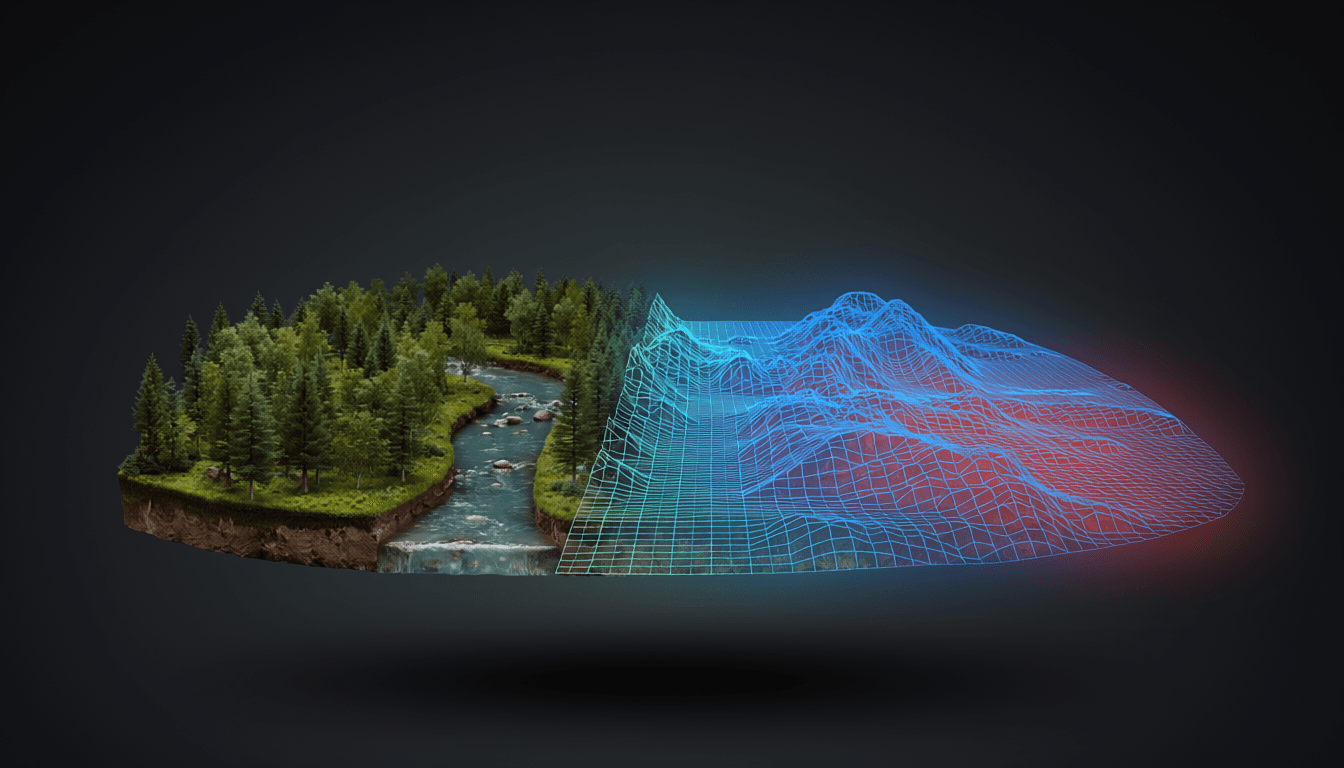
Ecosystem digital twins create living models of environmental systems:
- Watershed digital twins: Integrate terrain models, land use data, meteorological inputs, streamflow gauges, water quality sensors, and ecological surveys into a continuously updated model that predicts how the watershed responds to storms, land use changes, climate shifts, or contamination events
- Coastal zone models: Combine tidal dynamics, sediment transport, sea level rise projections, and habitat mapping to predict shoreline evolution and ecosystem health under different management scenarios
- Urban environmental models: Fuse air quality, noise, heat island, stormwater, and green infrastructure data to optimize city planning for environmental performance
These differ from traditional environmental models because they are continuously calibrated with real data and operationally used for decision-making — not one-time assessment tools that are archived after permitting.
The shift: Environmental assessment becomes a continuous operational capability rather than a one-time regulatory exercise.
Reference: EPA's research on integrated environmental modeling. WEF (Water Environment Federation) publications on digital water. The International Environmental Modelling and Software Society (iEMSs) promotes computational environmental management.
From Treatment Plant Design to ML-Optimized Water and Wastewater Operations
Traditional water and wastewater treatment plant design follows established design criteria: BOD loading rates, hydraulic retention times, sludge ages, and disinfection contact times derived from decades of empirical experience. These criteria are conservative — they ensure performance under worst-case conditions but don't adapt to actual conditions.
ML-optimized treatment operations adapt in real time:
- Chemical dosing optimization: ML models predict the optimal coagulant, polymer, and disinfectant doses based on incoming water quality (which changes hourly) rather than using fixed dosing rates — reducing chemical costs by 15-30% while maintaining effluent quality
- Aeration control: In activated sludge wastewater treatment, aeration accounts for 50-60% of energy consumption. ML models predict dissolved oxygen demand and optimize blower operation — reducing energy use without compromising biological treatment
- Process upset prediction: ML trained on years of operational data detects subtle patterns that precede process upsets (bulking sludge, nitrification failure, taste-and-odor events) — enabling intervention hours or days before the problem becomes acute
- Nutrient removal optimization: Biological nutrient removal involves complex microbial ecology that empirical design criteria approximate crudely. ML models learn the actual relationships between operating conditions and nutrient removal performance at each specific plant
The shift: Treatment plant operation moves from conservative fixed-setpoint control to adaptive optimization that responds to real conditions.
Reference: WEF (Water Environment Federation) and AWWA (American Water Works Association) publications on digital water and AI in water treatment. EPA's research on intelligent water systems. IWA (International Water Association) digital water programme.
The Tool Ecosystem
Tool Ecosystem: Traditional vs. DE-Native
What Environmental Engineers Need to Learn
Environmental engineering fundamentals — chemistry, hydrology, ecology, regulatory frameworks — remain essential. You can't optimize a treatment plant if you don't understand biological treatment, and you can't build an ecosystem digital twin without understanding the ecology it represents. The digital engineering additions:
- Sensor technology and data management: Understanding what sensors measure, their limitations (drift, fouling, calibration), and how to manage the volume of data that continuous monitoring produces
- Machine learning for environmental systems: Environmental data is noisy, non-stationary, and often spatially and temporally correlated. Standard ML techniques need adaptation for these characteristics
- Geospatial data science: Environmental engineering is inherently spatial. GIS, remote sensing, and spatial statistics are foundational tools that become more powerful when combined with ML
- Systems-level thinking: Environmental problems cross boundaries — a watershed doesn't stop at a city limit, and air pollution doesn't respect property lines. Digital environmental engineering requires integrating data and models across jurisdictional and disciplinary boundaries
Key Organizations and Resources
- EPA — Environmental Protection Agency, research programs on integrated modeling, smart water infrastructure, and computational environmental science
- ASCE EWRI — Environmental & Water Resources Institute, publications and conferences on computational environmental engineering
- AGU — American Geophysical Union, earth system science publications increasingly featuring ML and computational methods
- WEF — Water Environment Federation, digital water initiative and publications on AI in wastewater treatment
- AWWA — American Water Works Association, smart water infrastructure programs
- IWA — International Water Association, digital water programme and global research on AI-optimized water systems
- IPCC — Intergovernmental Panel on Climate Change, computational modeling underpinning climate assessment reports
- NOAA — National Oceanic and Atmospheric Administration, AI-enhanced weather and climate prediction programs