Manufacturing Engineering
From static process plans to closed-loop adaptive factories
 Cp = (USL-LSL)/6σMRR = v·f·dOEE = A×P×Q
The Traditional Practice
Manufacturing engineering has always been data-rich. CNC machines log spindle loads and tool positions. Quality systems record dimensional measurements on every critical feature. Production databases track cycle times, scrap rates, and equipment uptime. Statistical Process Control (SPC) has been standard practice since the 1980s.
But this data has historically lived in silos. The CNC program doesn't talk to the quality system. The quality system doesn't talk to the supply chain database. SPC charts detect when a process has drifted — after defective parts have already been made. The data exists, but it flows in one direction (process to archive) rather than closing a loop.
Digital engineering in manufacturing is about closing these loops — connecting process data to quality prediction in real time, connecting factory-floor intelligence to supply chain decisions, and using AI to manage the combinatorial complexity of modern production systems.
What's Different Now
From Statistical Process Control to Closed-Loop Digital Twins
Traditional quality control is retrospective. SPC monitors process outputs (dimensions, surface finish, hardness) and triggers alarms when measurements drift outside control limits. The problem: by the time the SPC chart signals a shift, defective parts have already been produced. The response is reactive — stop the line, investigate, adjust, restart.
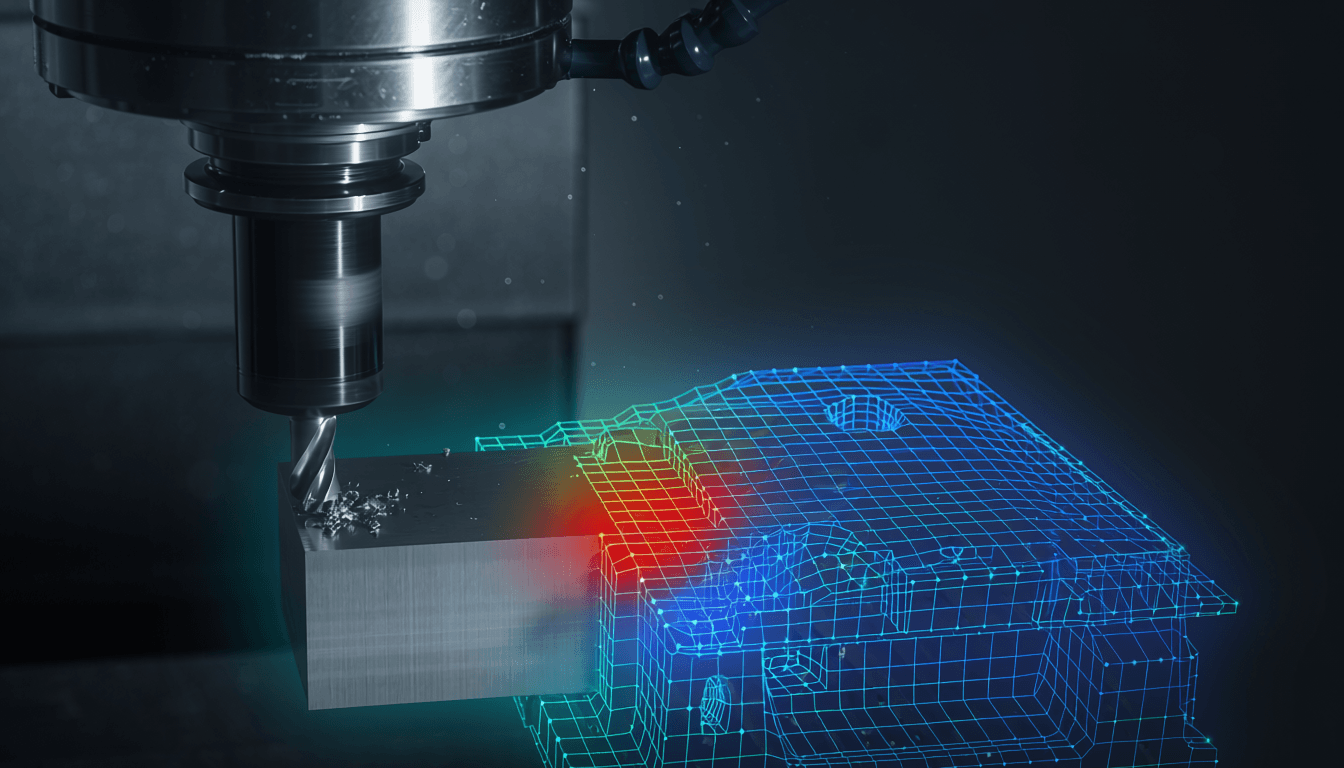
Closed-loop process digital twins make quality control predictive and real-time. A digital twin of a machining operation, for example, ingests live sensor data — spindle current, vibration spectra, coolant temperature, feed forces — and uses a physics-ML hybrid model to predict the dimensional accuracy and surface integrity of the part while it's being cut.
When the model predicts that the next feature will exceed tolerance:
- Adaptive parameters adjust feed rate, spindle speed, or tool path in real time
- Tool wear compensation updates offsets based on predicted (not measured) wear
- The system flags the part for targeted inspection rather than scrapping it or letting it pass unchecked
The shift: Quality moves from post-process detection to in-process prediction and correction.
Reference: NIST's Manufacturing Extension Partnership (MEP) promotes smart manufacturing adoption. ISO 23247 defines a digital twin framework for manufacturing. CESMII (Clean Energy Smart Manufacturing Innovation Institute, a DOE-funded institute) develops open-source smart manufacturing architectures.
From Recipe-Based Production to AI-Optimized Process Planning
Traditional process planning follows recipes: for this material and this geometry, use these cutting parameters, this sequence of operations, and these quality checkpoints. These recipes are developed through experience, handbook guidelines, and qualification testing. They work well for stable, high-volume production — but they're rigid.
AI-optimized process planning adapts to variability:
- Material variability: Incoming material properties vary batch to batch. AI adjusts process parameters to the actual material, not the nominal specification — if this batch of aluminum is slightly harder, the feeds and speeds change automatically
- Geometric complexity: For additively manufactured or hybrid parts with complex geometries, AI generates process plans that account for thermal distortion, residual stress, and support structure removal — problems that conventional recipes don't address
- Multi-objective optimization: Traditional planning optimizes for one thing (usually cycle time). AI simultaneously optimizes cycle time, tool life, energy consumption, and quality — finding trade-offs that human planners can't evaluate across thousands of possible parameter combinations
The shift: From fixed recipes applied to nominal conditions to adaptive planning that responds to actual conditions.
Reference: SME (Society of Manufacturing Engineers) publishes extensively on AI applications in process planning. ISA (International Society of Automation) standards for industrial automation and control. The International Academy for Production Engineering (CIRP) research on intelligent manufacturing.
From Periodic Inspection to AI Quality Prediction from Process Signatures
Traditional quality assurance inspects finished parts — measuring dimensions on a CMM, checking surface finish with a profilometer, testing hardness with a Rockwell tester. This is accurate but slow, expensive, and happens after the value has been added. First-article inspection can take hours for complex parts.
Process signature-based quality prediction uses in-situ sensor data to predict quality outcomes before the part leaves the machine:
- In welding: Current, voltage, wire feed speed, and thermal imaging during the weld predict joint quality (penetration, porosity, lack of fusion) without destructive testing
- In additive manufacturing: Melt pool monitoring (photodiode, thermal camera), layer imaging, and acoustic emission data feed ML models that predict density, porosity location, and mechanical properties — layer by layer, in real time
- In heat treatment: Thermocouple arrays, furnace atmosphere sensors, and quench monitoring predict hardness and microstructure — replacing end-of-batch destructive testing with in-process prediction
This doesn't eliminate all inspection — it enables risk-based inspection strategies where parts predicted to be compliant get reduced inspection while parts flagged by the model get enhanced scrutiny.
The shift: Quality evidence comes from the process, not just the product.
Reference: NIST's Measurement Science for Additive Manufacturing program. ASTM E3166 on in-situ monitoring for additive manufacturing. IEEE Industrial Electronics Society publications on intelligent quality monitoring.
From Reactive Supply Chains to Autonomous Disruption Response
Traditional supply chain management operates on forecasts, safety stock, and manual intervention when disruptions occur. When a supplier misses a delivery, a procurement specialist calls alternates. When demand spikes, production schedulers manually rebalance the floor. These responses take days to weeks — and the decisions are based on incomplete information because supply chain data is fragmented across ERP systems, supplier portals, and spreadsheets.
Autonomous supply chain optimization uses AI to detect and respond to disruptions in real time:
- Demand sensing: ML models ingest point-of-sale data, economic indicators, weather forecasts, and social media signals to predict demand shifts weeks before traditional forecasting methods detect them
- Supplier risk monitoring: NLP models scan news feeds, financial filings, and logistics data to flag supply chain risks — a supplier's port is congested, a raw material price is spiking, a critical sub-tier supplier is financially distressed
- Dynamic scheduling: When disruptions occur, optimization algorithms rebalance production across machines, lines, and factories within hours — considering constraints (tooling, certification, capacity) that human schedulers track in their heads
The shift: Supply chain response moves from reactive and manual to predictive and algorithmic.
Reference: APICS/ASCM (Association for Supply Chain Management) publications on AI in supply chain. ISA-95 (enterprise-control system integration) and ISA-88 (batch control) standards. DOE's Smart Manufacturing Innovation Institute (CESMII) supply chain integration programs.
The Tool Ecosystem
Tool Ecosystem: Traditional vs. DE-Native
What Manufacturing Engineers Need to Learn
Manufacturing engineering fundamentals — process physics, GD&T, quality systems, production management — remain essential. The digital engineering additions:
- Sensor data engineering: Understanding what sensors measure, how to condition signals, and how to extract features that correlate with quality outcomes — the raw material for process digital twins
- Machine learning for manufacturing: Especially supervised learning for quality prediction, time-series analysis for equipment health monitoring, and reinforcement learning for adaptive control
- Systems integration: Manufacturing digital engineering requires connecting OT (operational technology) on the shop floor with IT systems (ERP, PLM, MES) — understanding protocols, data models, and cybersecurity across both worlds
- Optimization under constraints: Real manufacturing optimization involves hard constraints (machine capacity, tooling availability, certification requirements) that make the problem fundamentally different from textbook optimization
Key Organizations and Resources
- SME — Society of Manufacturing Engineers, publications and conferences on smart manufacturing and Industry 4.0
- CESMII — Clean Energy Smart Manufacturing Innovation Institute (DOE), open-source smart manufacturing platform and reference architectures
- NIST MEP — Manufacturing Extension Partnership, technology adoption programs for small and medium manufacturers
- ISA — International Society of Automation, standards for industrial automation (ISA-95, ISA-88, ISA/IEC 62443 cybersecurity)
- IEEE Industrial Electronics Society — Publications on intelligent manufacturing, industrial AI, and cyber-physical production systems
- ISO 23247 — Digital twin framework for manufacturing, defining interfaces and information models
- ASTM International — Standards for additive manufacturing process monitoring and qualification (E3166, F3122)