Mechanical Engineering
From hand-designed parts to generative topologies
 σ = Eε∇·σ + f = 0ρ(∂v/∂t) = -∇p + μ∇²v
The Traditional Practice
Mechanical engineering is the broadest engineering discipline — spanning thermodynamics, solid mechanics, fluid dynamics, dynamics and control, manufacturing, and materials. Computation has been central since the 1960s: FEA for stress analysis, CFD for fluid flow, and CAD for geometry creation and documentation.
The digital engineering transformation in MechE isn't about adopting computation — it's about making computation native rather than a service, and connecting the streams of information that computation produces.
What's Different Now
From Analysis to Generation
Traditional mechanical design follows a human-driven loop: the engineer conceives a geometry, builds a CAD model, runs FEA to check it, modifies the design based on results, and iterates. The human does the creative work; the computer checks the homework.
Generative design inverts this. The engineer defines the problem — loads, constraints, material options, manufacturing method, and objectives (minimize mass, maximize stiffness) — and the algorithm generates candidate geometries. The computer does the creative exploration; the human evaluates and selects.
This isn't a small improvement. Topology optimization and generative algorithms explore regions of the design space that human designers would never consider. The resulting shapes are often organic, non-intuitive, and can outperform human designs by 20-40% on weight-to-stiffness ratios.
The key enabler: Additive manufacturing. Topology-optimized geometries are often unmanufacturable with traditional subtractive or formative processes. AM removes that constraint, creating a pull for generative methods.
Reference: ASME's Computers and Information in Engineering division and IDETC/CIE conference track DE research. ASME Journal of Mechanical Design regularly publishes on topology optimization and AI-driven design.
From Single-Point Analysis to Design Space Exploration
Traditional MechE analysis answers one question at a time: "Does this design meet the stress requirement?" Each FEA run takes minutes to hours. An engineer might evaluate 5-10 design variants over a project.
ML surrogate models change the economics. A surrogate is trained on a designed experiment of full-fidelity FEA runs (typically 100-500 runs) and then predicts FEA output in milliseconds. With a surrogate, an engineer can evaluate 10,000 design variants in the time it takes to run one FEA job.
This enables:
- Sensitivity analysis at scale: Which parameters most influence performance?
- Multi-objective optimization: Find the Pareto frontier between weight, cost, and performance — not just the best single design
- Uncertainty quantification: How does manufacturing variability affect performance? Monte Carlo with 10,000 evaluations is impractical with full FEA but trivial with a surrogate
The shift: From "does this design work?" to "what is the best possible design, and how confident are we?"
Reference: ASME Journal of Mechanical Design, AIAA Journal. Gaussian process surrogates and neural network metamodels are active research areas at Stanford, MIT, Northwestern, and TU Munich.
From Design-Phase Models to Operational Digital Twins
Traditional MechE models are design artifacts. The FEA model predicts how a part will perform under assumed conditions. Once the part is manufactured, the model is archived.
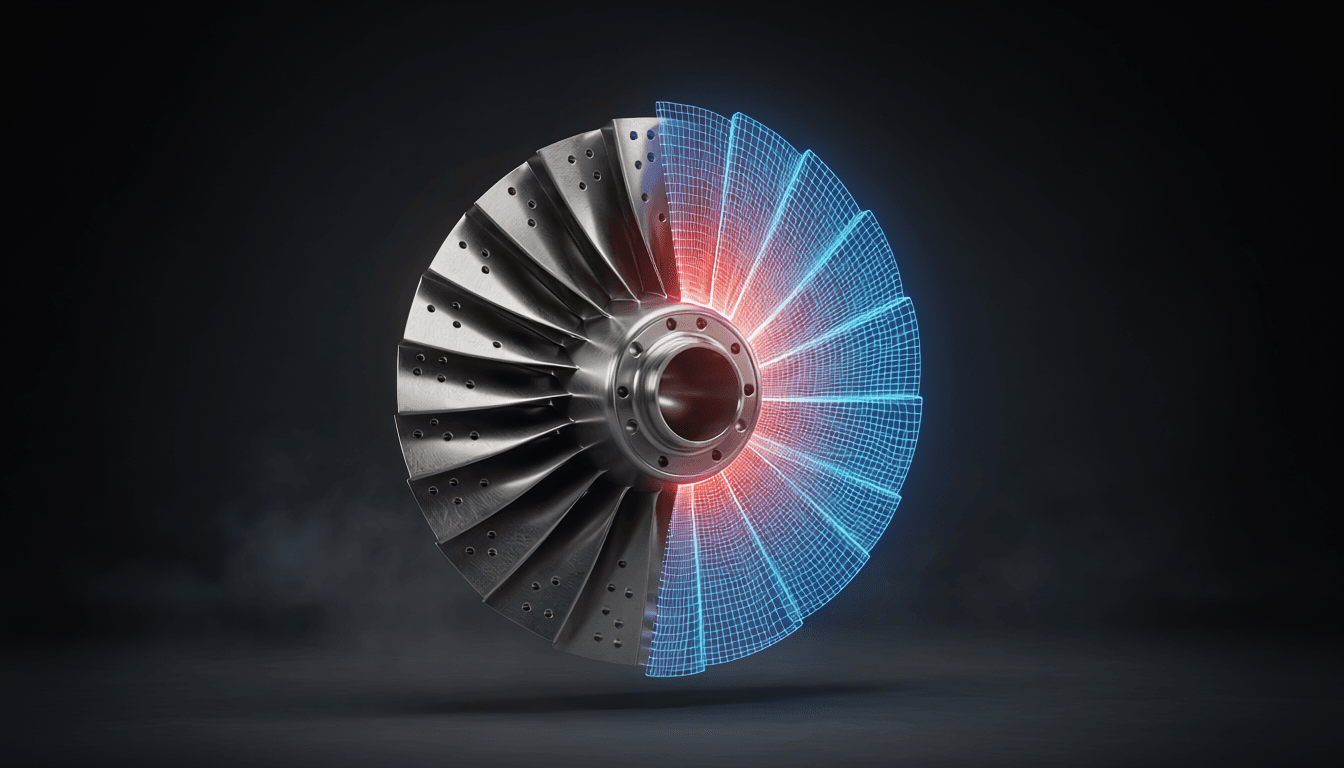
Operational digital twins extend the model's life. A turbine blade's FEA model, calibrated with as-manufactured geometry (from CT scanning) and updated with operational sensor data (temperatures, pressures, vibration), becomes a living prediction of that specific blade's remaining useful life.
This requires connecting information streams that were historically disconnected:
- Design data: CAD geometry, material specifications, FEA results
- Manufacturing data: As-built dimensions, surface finish, heat treatment records
- Operational data: Sensor telemetry, duty cycles, environmental conditions
- Maintenance data: Inspection findings, repairs, component replacements
When these streams are associated, you can answer questions that no single stream can answer alone: "Given how this specific turbine blade was manufactured and how it's been operated, when will it need replacement?"
Reference: GE Aviation's digital twin program for jet engines. Siemens MindSphere for industrial IoT-connected twins. ASME's Digital Twin Standards Committee (V&V 10.1).
From Manual Drafting Workflows to Automated Pipelines
Traditional MechE workflows involve significant manual handoffs: the designer creates geometry in CAD, exports it to meshing software, the analyst sets up boundary conditions, runs the solver, post-processes results, writes a report, and emails it to the designer. Each handoff is a potential error point and a time delay.
Automated engineering pipelines encode this workflow as code:
- Parametric CAD model generates geometry from design parameters
- Automated meshing with quality checks
- Boundary conditions pulled from the requirements model
- Solver runs on cloud compute
- Results automatically compared against acceptance criteria
- Dashboard updates in real time
A design change triggers the pipeline automatically. The engineer sees results in minutes, not days.
The shift: From sequential handoffs between specialists to automated, continuous analysis.
Reference: ASME's Verification & Validation standards (V&V 10, V&V 20).
The Tool Ecosystem
Tool Ecosystem: Traditional vs. DE-Native
What Mechanical Engineers Need to Learn
MechE fundamentals remain essential — you can't generate a good design if you don't understand the physics that governs it. What's added:
- Optimization theory: Understanding objective functions, constraints, Pareto optimality, and algorithm selection
- Data science basics: Surrogate modeling, design of experiments, uncertainty quantification
- Programming: Python for pipeline automation, API integration, and data processing — CAD and FEA APIs are increasingly scriptable
- Systems perspective: Understanding how your component fits into the larger system's digital thread — not just designing the part, but connecting your design data to manufacturing, test, and operations
Key Organizations and Resources
- ASME — Computers and Information in Engineering division, IDETC/CIE conferences, V&V standards, Digital Twin Standards Committee
- AIAA — Digital Engineering Integration Committee (overlaps with aerospace MechE)
- SAE International — Automotive and aerospace mechanical engineering standards
- ISO — Standards for product data (STEP/AP242), digital twins, and simulation credibility